★★★★★
I'd been quietly avoiding hikes for five years. Three weeks after my procedure I did a 6-mile loop in Hartshorne with zero pain. I cried at the trailhead.
M
Marisol R.

Walk pain-free again — minimally invasive, in-office, board-certified
Our minimally invasive bunion procedure corrects the deformity through incisions just a few millimeters wide, guided by live X-ray imaging and stabilized with small internal screws — so most patients are walking that day and back in regular shoes within weeks.

A bunion (hallux valgus) forms when the bone at the base of your big toe drifts out of alignment. The visible bump is just the surface symptom — the real issue is a joint that's progressively shifting and grinding with every step.
About 70% of cases run in families. Tight shoes don't cause bunions — but they make a predisposed foot worse, faster.
Bunions don't shrink on their own. Once they're symptomatic, every additional year typically widens the angle by 1–2°.
A 12° drift treated now means a smaller incision, faster recovery, and far better long-term outcome than waiting until 30°+.
Most patients put it off for years. The truth is that an early consult costs you 30 minutes and tells you exactly where you stand — even if the answer is "wait and watch."
A dull throb that builds up after 2–3 hours on your feet — and lingers into the evening even after you've sat down.
Your big toe is starting to angle toward the second toe. You can no longer wear shoes you wore comfortably 2 years ago.
The bump is warm to the touch by end of day, or visibly inflamed after exercise or a long walk.
You've upsized — or you only wear wide-toe-box shoes now. Dress shoes are off the table.
The skin around the joint or under the second toe has thickened from the pressure shift.
You've quietly stopped — long walks, runs, hikes, dance class. The bunion is shaping how you spend your weekends.
Open bunionectomy was the standard of care for decades and still has a place — for severe deformities. But for the majority of bunions, minimally invasive surgery (MIS) now produces an equivalent structural result with substantially less downtime.
We see patients at every stage — from a 10° drift with occasional discomfort to a 40° deformity that's been grinding for a decade. Where you fall on that spectrum determines whether surgery is the right call now, soon, or not yet.
A mild bunion that isn't limiting your activity or causing daily pain is worth monitoring, not operating on. We'll take a weight-bearing X-ray, measure the intermetatarsal angle, and give you a baseline. Come back in 12 months and we'll compare. If the angle is stable and you're not suffering, the right move is to watch it.
A 20° drift treated now means a smaller correction, less disruption to surrounding structures, and a faster recovery than the same foot at 30°. Most patients in this range are full candidates. Disqualifiers: active infection, uncontrolled diabetes, severe peripheral vascular disease, or bone quality that won't support fixation — we identify all of these at consult.
At this stage, the joint has typically been remodeling for years. Minimally invasive correction can still work for many severe bunions, but cases with significant joint arthritis or a very wide intermetatarsal angle are better served by an open technique with broader internal fixation. We'll tell you honestly which one applies to your foot.
A small number of patients aren't candidates for elective bunion correction regardless of severity. If any of these apply, bring it up at the consult — some are absolute, some are manageable with the right preparation.
Bunions don't stabilize on their own once they're symptomatic. The average progression is 1–2° per year in a foot that's already drifting. That doesn't sound like much until you realize that a 22° bunion at age 45 becomes a 32° bunion at 50 — the difference between a straightforward MIS procedure and a more involved reconstruction.
Waiting also tends to involve quiet compromises: the hike you skip, the shoe section you avoid, the evening events you cut short because your foot is throbbing. Those losses are real and cumulative, even if they don't show up on an X-ray.
That said — if your bunion is stable, small, and not limiting your life, waiting is a completely reasonable choice. We'll tell you which category you're in.
Not sure where your bunion falls? Bring your most recent X-ray to the consult — or we'll take a fresh weight-bearing image in the office. You'll leave with a clear answer.
Book a free consult ›From check-in to walking out the door, plan on about 90 minutes. You don't need a driver — local anesthetic only, no sedation, no overnight stay.
We capture a fresh weight-bearing X-ray and trace the exact correction angle on your image. You'll see the planned outcome — bone-by-bone — before we start.
A targeted nerve block numbs the foot from the ankle down. You stay fully awake and chatty — most patients listen to a podcast through the procedure.
Through a handful of small openings, the surgeon uses specialized instruments under live X-ray to reshape and reposition the metatarsal, then secures the correction with small internal screws. Minimal soft-tissue disruption, no large hardware.
One small bandage, a post-op walking boot, and you walk out under your own power. Your follow-up is set for day 7 to confirm alignment is holding.
Healing is biological and varies by patient, but this is the median path our 412 most-recent patients followed. We'll give you a personalized version of this on day 1.
Foot elevated for the rest of the day. Most patients are off pain medication by bedtime.
Bandage off. New X-ray confirms alignment. Light desk work resumes for most.
Boot is gone for the majority. Walking is normal. Some swelling at end of day is expected.
Light running, hiking, gym work. We stage your return so the joint isn't stressed too soon.
Scar fades to a thin line. The deformity is fully corrected. You forget about your foot.
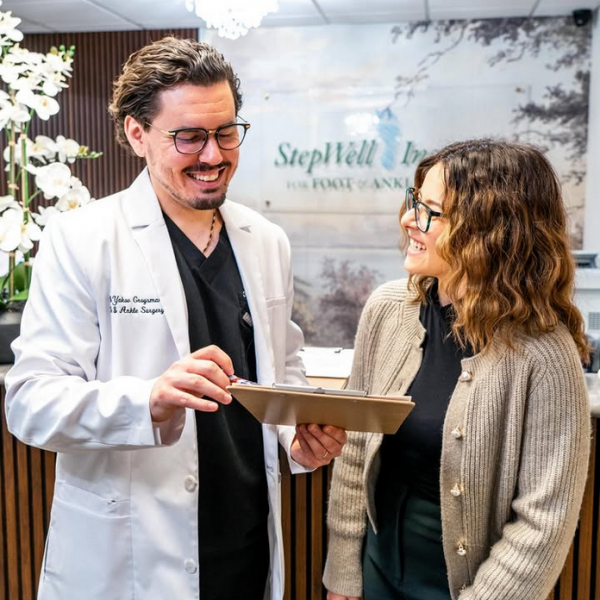
Board-certified podiatric surgeon with over 15 years of experience in advanced foot and ankle care. Dr. Groysman is fellowship-trained in minimally invasive forefoot reconstruction and has personally performed over 2,000 bunion corrections. He believes in treating every patient as a person — not a problem — addressing root causes before reaching for surgery.
Quick clips from our patients, procedures, and day-to-day at the institute. Tap any short to play it through.
We're in-network with the major regional carriers and we'll run a free benefits check before you ever schedule the procedure.










If yours isn't here, the consult is the right place — bring your X-rays from another office and we'll go over them together at no charge.
You'll meet Dr. Groysman, see your foot on his screen, and walk out with a clear answer about whether you need surgery, when, and what it'll cost. No pressure, no follow-up sales calls — that's not how we work.
Most new patients get on the calendar within 3 business days.
We run your benefits before you arrive so the conversation is real.
A real person at our front desk, business hours, no chatbot.
Because true minimally invasive bunion care isn't available at every podiatry practice. If you're within 45 minutes, we're worth the drive — the procedure takes one morning, the recovery is one month, the result is the rest of your life.
The procedure takes one morning. The recovery is one month. The result is the rest of your life.